You have almost certainly heard much about the
planets of our Solar System, and have likely seen the beautiful
pictures space probes have made of each of them from nearby. But what
some people don't know is that you don't need to go to other planets
to see them: they're all visible from Earth. In fact, a couple of
them are just about the easiest things to find in the sky, and each
of them is fun to see. So for those who are curious, but haven't seen
the planets yet (or not all of them) I have written a little guide,
starting with the easiest planet to see in 2013 and working my way up
to the hardest. Give it a try some night, seeing another planet is
not much harder than seeing the Moon once you know where (and when)
to look! All you need is at least one eye and a clear sky.
Jupiter
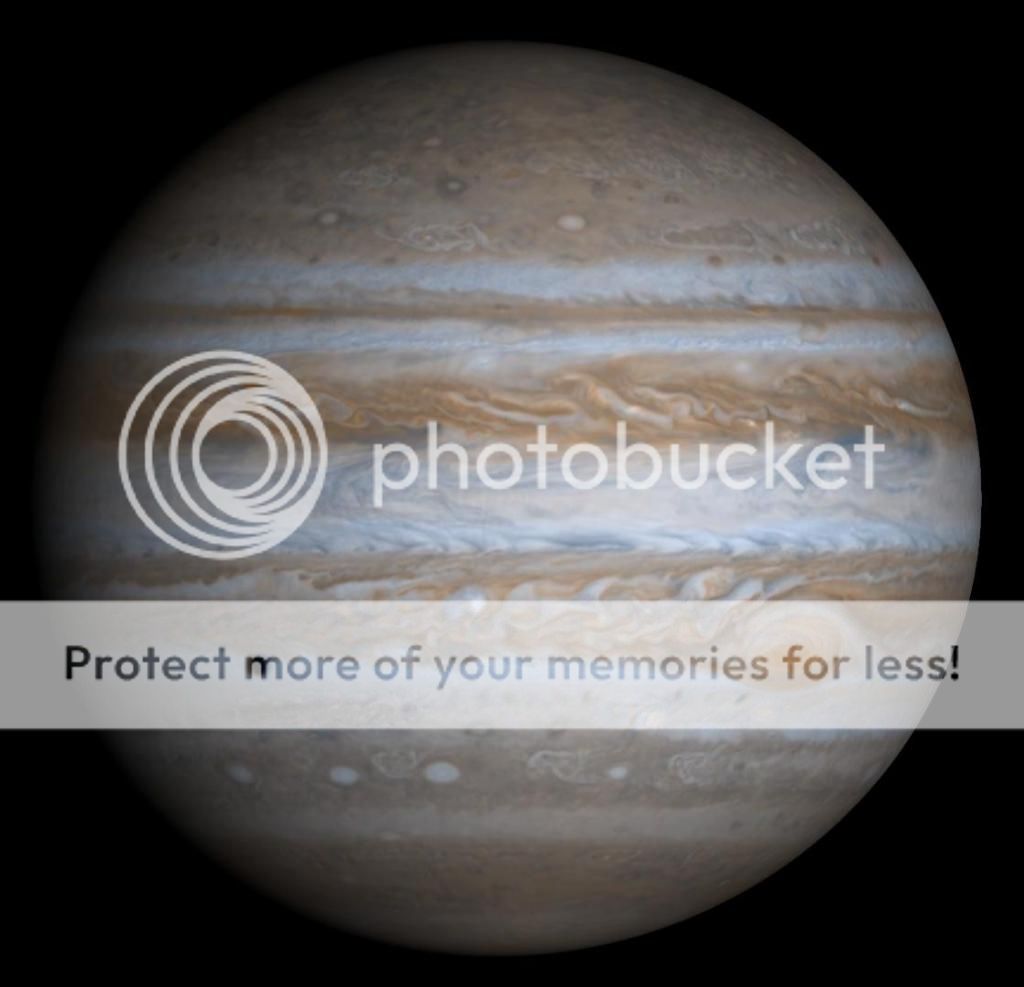
(Image credit: NASA)
The Romans named Jupiter after the king of their
gods, and if you've ever seen it on a dark night, it's not hard to
see why. Jupiter is far brighter than any star and easily dominates
the night sky if the Moon isn't out. This makes it the easiest
planet to see in many years, including 2013. Jupiter is very bright
due to its enormous size, which means it reflects a lot of light.
Right now, Earth is passing between Jupiter and the
Sun, and this means Jupiter is at its closest to us(and therefore
brightest), and that Jupiter rises right as the Sun sets and sets as
the Sun rises. That makes any cloudless night these months an awesome
time to look at Jupiter. In the early evening, you can see it shine
brightly in the east, even from the most light-polluted cities.
Around midnight, it passes very high through the south, easily the
brightest “star” in the sky. Early in the morning, it sinks down
into the west as the Sun rises in the east. Due to Jupiter's
brightness, you probably won't need a star chart or any knowledge of
the sky to find it. It's brightness makes it stand out easily: for
most of the night it's the brightest object in the sky other than the
Moon (which, by the way, will approach Jupiter very closely in the
sky on 26 December, and even cover it seen from South-America and
Africa). But in case you need more help, it's in the constellation of
Taurus. It's easy to find due to a large hexagon of very bright stars
in the sky, often called the Winter Hexagon. It's near the star
marking its right corner, Aldebaran, but way brighter than this star:

(Image of the brightest stars of the winter sky made
using SpaceEngine. Jupiter is the bright object on the right of the
large hexagon. Brighter stars are larger in the picture than smaller
ones. It helps to look at this picture in full view)
While Earth is passing between Jupiter and the Sun
now, it will slowly move away during 2013's early months. Jupiter
will stay in the same area of sky, but will set earlier every day. By
March, it'll be in the south around sunset, and sink into the west
during evening, setting around midnight. In May and June, Jupiter
will pass on the other side of the Sun and therefore be invisible
from Earth. But in July it will become visible again very early in
the morning, rising about three hours before the Sun in the east. In
the final months of the year, Earth will approach Jupiter again and
it will rise earlier all the time, so by December 2013 it will once
again be visible the whole night long.
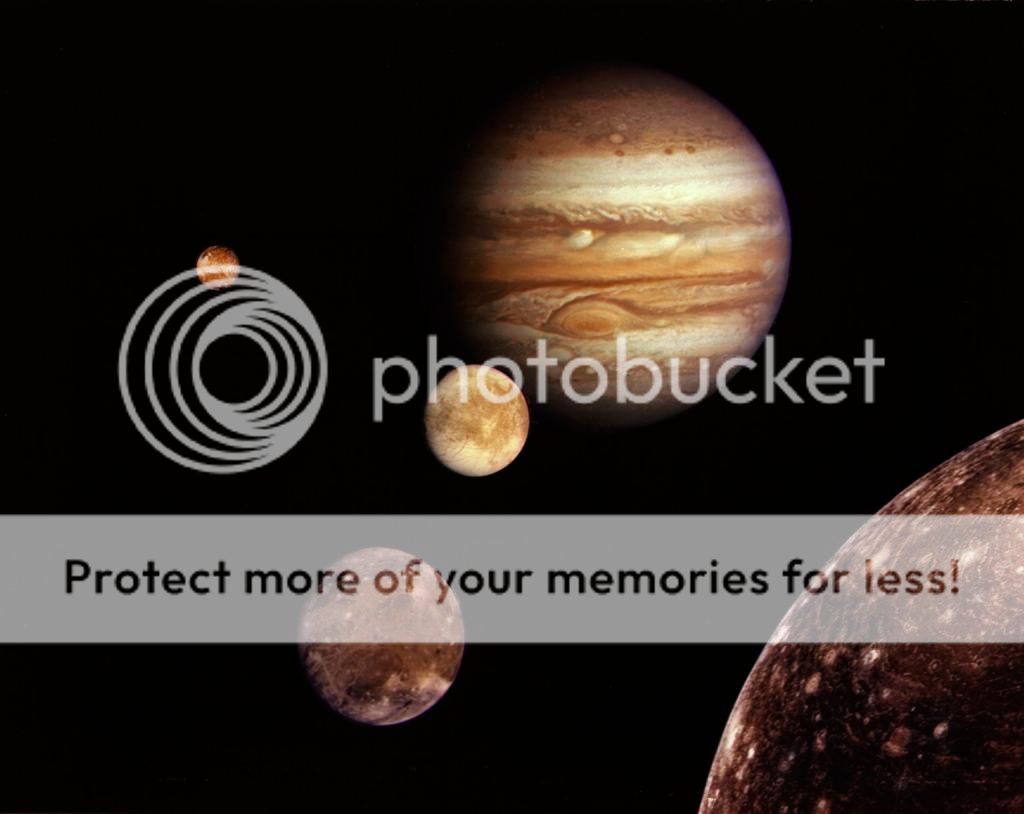
(Image credit: NASA)
Jupiter is a beautiful sight with the naked eye, but
if you have binoculars or a telescope you can see something very
cool: its four largest moons! They're called Io, Europa, Ganymede,
and Callisto, and each is the size of a small planet (Ganymede is in
fact larger than Mercury). The only reason we can't see them with the
naked eye in the first place is that Jupiter's bright light is in the
way, but with binoculars, even poor ones, you can see them separate
from Jupiter. They're visible as four “stars” close to Jupiter
(or three, or two, or occassionally just one; they often pass behind
or before Jupiter so they're not visible), roughly on a straight
line. If you look at them from day to day, you can see they're in
different places each time due to their fast orbits. With good
binoculars it also becomes possible to see Jupiter as more than a
point of light, but actually see it as a sphere. You won't be able to
see its beautiful clouds, though: you need a telescope for that.
Venus

(Image credit: NASA)
Maybe you have seen something very strange in the
sky once. A mysterious light hovering above the western horizon in
the evening, or maybe it was above the eastern horizon early in the
morning before the Sun was up. It was obviously far too bright to be
a star, but unlike a plane it didn't move at all. It just hung there
silently. Was is a spaceship from another world?
Well, no. In fact, it was another
world: Venus. Venus is ludicroudly bright, as much as six times
brighter than Jupiter. Other than the Moon and the Sun, nothing in
our skies is brighter. She gets so bright because A: she's the
closest planet to Earth, B: she's covered in bright white clouds,
reflecting a lot of light, and C: she's close to the Sun, so brightly
lit. Venus is bright enough even to cast shadows in places that are
very dark. (in any place in or near a city these very faint shadows
are washed out by the light pollution though)
So if Venus is so bright,
why do I consider Jupiter the easiest planet to see? Well, there's a
catch: Venus is closer to the Sun than Earth, so in the sky she's
always near the Sun. Jupiter can be nearly overhead in the sky in the
middle of the night, but Venus is always near the Sun so it's usually
day when she's in the sky. However, at dawn or dusk she is often
visible and makes even Jupiter look faint then. Right now Venus rises
shortly before the Sun, but she's about to pass behind it, becoming
invisible to us Earthlings from mid-January on. She won't emerge on
the Sun's other side until June, and then she'll be visible low in
the evening sky for the rest of the year. She'll follow the setting
Sun, setting one to three hours after it and gracing the western
evening sky with her brightness. You really don't need a star chart
to see Venus; it's a matter of looking to the west in the second half
of the year about an hour after the Sun sets: Venus is unmistakable.
Much like Jupiter, Venus
also has a bonus if you look at her with binoculars. They need to be
binoculars on a tripod, though: holding them in your hand won't make
them steady enough. But if you have binoculars on a tripod and aim
them at Venus, you can probably just make out that the planet doesn't
look round, but has the shape of a crescent Moon. This is because
Venus is closer to the Sun than Earth, so we're looking at it more or
less from behind.
I've said it before:
Venus is bright. But in fact, she's so bright she's visible at day!
You've probably seen the Moon at day some time, but not Venus. This
is because Venus is very easy to miss. Unlike the Moon, she's just a
tiny little dot of white among a sea of blue sky. But she's visible
if you know where to look. October will likely be the best time to
try: Venus will be at her farthest away from the Sun. To try it, find
a spot where the Sun is just out of your sight: this will prevent
your eyes hurting from looking roughly in its direction. So you need
to be in the shadow, but left of the Sun (in the east) you need to be
able to see the sky. Sitting in a place where a tree or building
covers the Sun is probably the best idea.
Venus will be a bit over
forty degrees to the Sun's east. To measure out these forty degrees,
spread your hand out at armlength. Provided you are not very weirdly
proportioned, the distance from the tip of your thumb to the tip of
your pinky is roughly twenty degrees at arm's length. So you look two
of these distances left of the Sun. The best times to do this would
likely be 14:30 (at that time, Venus will approximately at the same
height as the Sun). Most likely, however, you will see nothing there
at first, just blue sky. Well, keep looking at the area, scanning it
carefully with your eyes: the detail of a tiny white spot against the
blue sky is too slight to be picked up by your peripheral vision, so
you need to see it with the centre of your sight. Don't give up: it
takes a while to find.
There's another situation
when Venus is visible at day: when it passes exactly between the Sun
and Earth. It's visible as a little black dot during these Venus
transits. This happened in June, but unfortunately won't happen again
until 2117.
Saturn

(Image credit: NASA)
Just like Jupiter, Saturn is huge. But it's almost
twice as far away from the Sun, so it gets less light, and is also
further away from Earth. Because of this Saturn isn't as bright as
Jupiter, but it's still a bright planet. It's about as bright as the
brightest stars, so you'll need a little knowledge of the
constellations to recognise it. Not much, though, as it's bright
enough to easily stand out among all but the brightest stars. Saturn
is in between the constellations Virgo and Libra at the moment, and
fortunately there's only one bright star nearby:
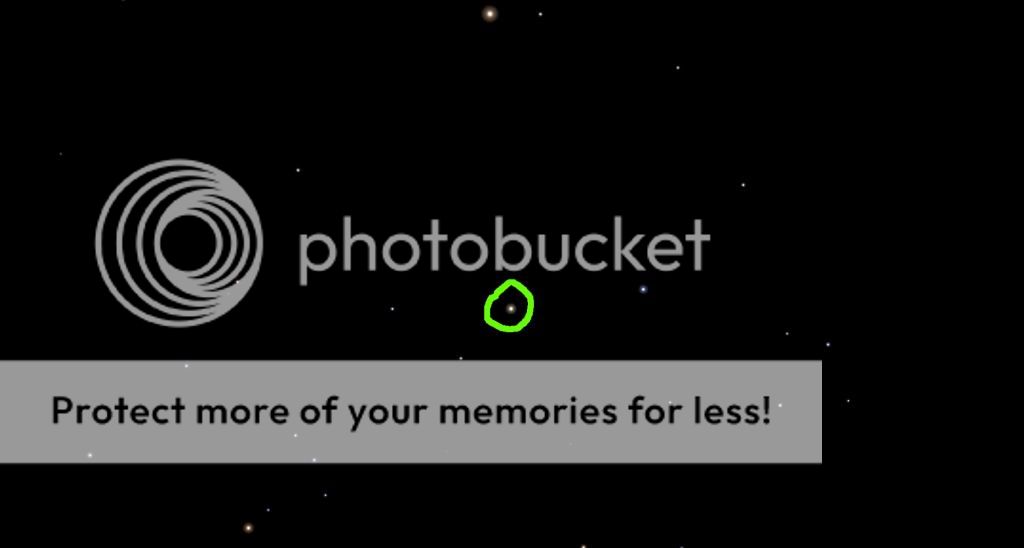
(Image of the spring sky near Saturn made using
SpaceEngine. The circled object is Saturn. Looking at the picture in full view helps)
Saturn doesn't rise until the morning right now, not
long before sunrise. But in the first few months of 2013 it'll rise
earlier all the time, until Earth passes between Saturn and the Sun
in April, when it'll be visible all night long as it rises when the
Sun sets and sets when the Sun rises. From June to September it'll
set during the night, and therefore will be visible in the evening
only. During October and November, Saturn will pass behind the Sun,
and therefore will be invisible. In December it'll start rising
before the Sun in the early morning again.
If you look at the southern sky in April or May, you
will see two bright “stars” near each other, with a third one
higher up in the sky. Saturn is the brightest of these three, at the
lower left of the triangle they form. It's also the only one that's
yellow-whitish; Spica (the star near Saturn) is a little bluish,
while Arcturus (the star above Saturn and Spica) is a bit reddish.
There are likely other stars visible as well, but none of them are as
bright as Saturn.
With a binocular on a tripod, Saturn's beautiful
rings can just be seen. To see them clearly separate from the planet
you need a telescope, but in binoculars the planet looks oddly
elongated, a bit egg-like due to the rings. Saturn also has one big
moon, Titan, which is just in the range of binoculars. It's very big,
bigger than Mercury, but Saturn's distance to the Sun makes it a lot
harder to see than Jupiter's big moons. A faint star nearby Saturn is
likely to be Titan, particularly one that moves from day to day.
Mars
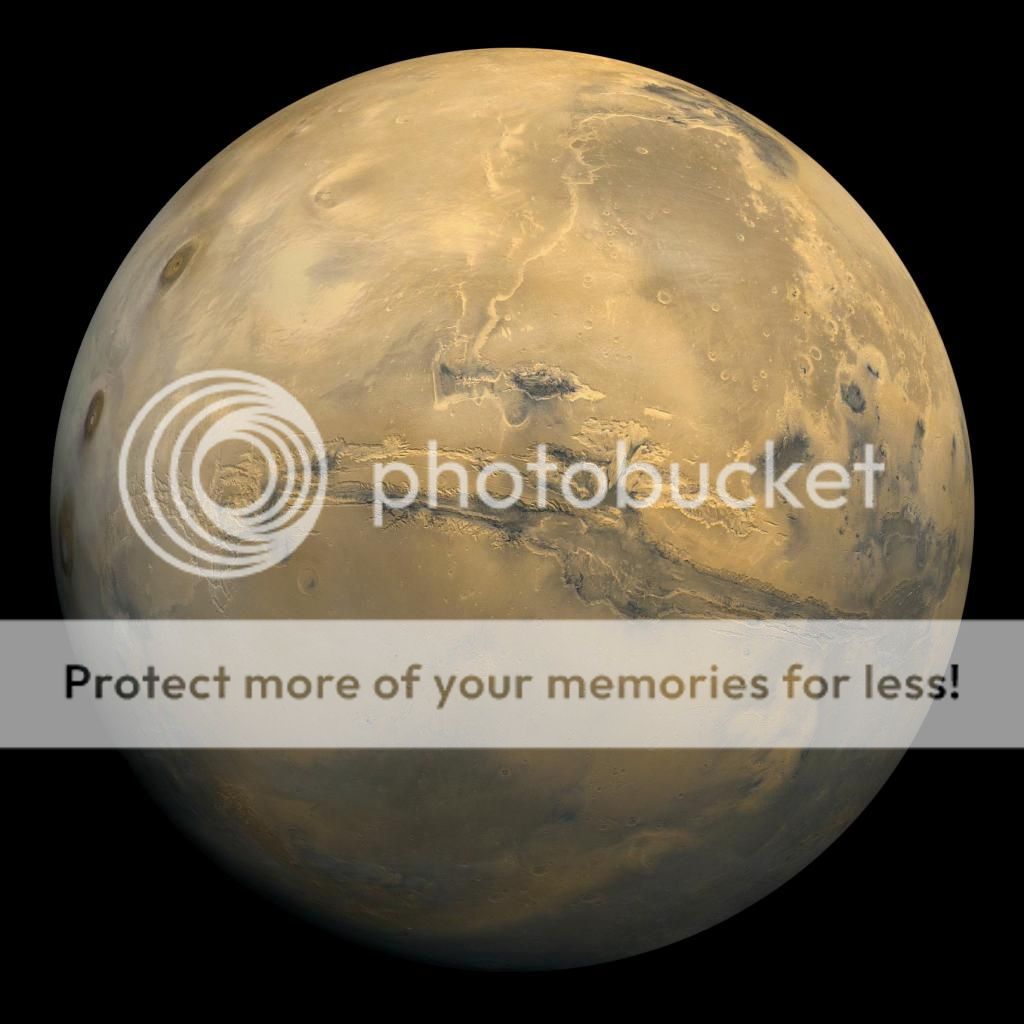
(Image credit: NASA)
After Venus, Mars is the closest planet to Earth.
This is both a blessing and a curse for seeing it: when Earth passes
between Mars and the Sun, the planets get very close and Mars becomes
brighter than any star, sometimes even brighter than Jupiter. It's a
fiercely bright red thing in the sky at these times. But Mars'
proximity also means it moves very fast compared to Earth, and that
at its furthest, it's as much as five times farther away than its
closest. It's very faint by comparison during these times, and this
is one problem.
The other problem is this: Mars orbits the Sun once
every 687 days*, while Jupiter takes twelve years over an orbit. This
means that if Mars and Jupiter were both behind the Sun seen from
Earth (and thus invisible), we need to wait only half a year for the
Earth to pass between Jupiter and the Sun: Jupiter moves little in
that time. Mars, on the other hand, will be long gone after half a
year, and has completed a good part of its orbit by then, so while
it's not precisely on the opposite side of the Sun any more it's
still quite far away and it'll be another half year before Earth gets
close to it.
This means there are great Mars years, when the
planets are close to each other all year long and Mars is really
bright. It also means there are awful Mars years, when Mars is in
hiding behind the Sun most of the year. 2013 is one of these awful
years, and this is why I've listed it behind Saturn (in a good year I
might have listed it as the easiest to see planet). In January 2013,
Mars sets less than two hours after the Sun. After this, it'll pass
behind the Sun for most of the year, and won't be visible again until
August, when it'll start rising before the Sun in the early mornings
(along with Jupiter, but Jupiter will be as fiercely bright as always
while Mars will look like an average star). It'll slowly rise earlier
and become brighter, but even in December it still doesn't rise until
1:00 and is no brighter than Saturn.
Mars' rapid movement also makes it hard to give a
star chart for its location, as it moves constellations about once
every two months, and is constantly on the move within those
constellations. So instead of making a dozen star charts, I will tell
you in which constellations it is in each month. Then you can look
that constellation up on Wikipedia for its star chart; the bright
star that's not on it will be Mars. In December 2012 and January
2013, it's in Capricorn, low in the southwest in the evening. In
July, it reappears in the northeastern morning sky in Taurus. In
August it'll be in Gemini, and in September in Cancer. It will spend
October and November in Leo, and end the year in Virgo.
Mercury
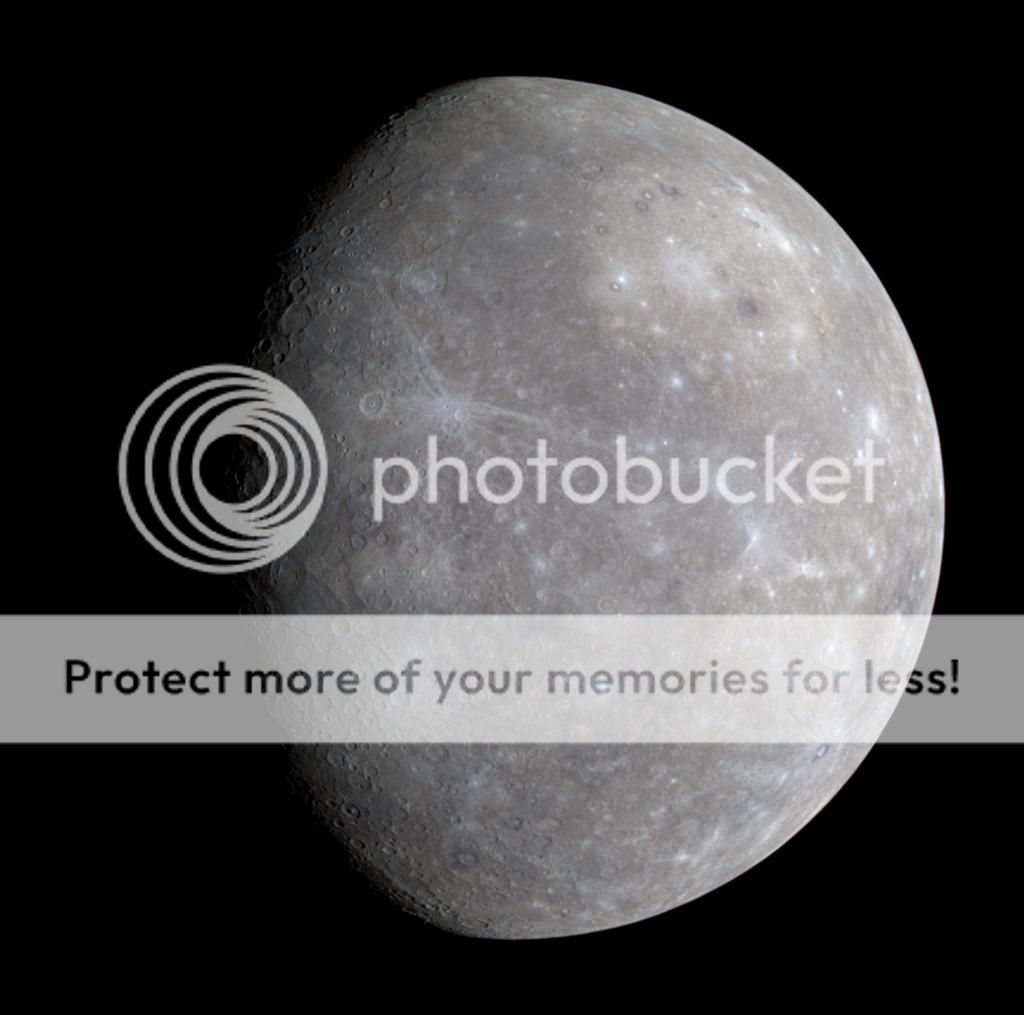
(Image credit: NASA)
Mercury is the smallest planet, but it's also
closest to the Sun and therefore very brightly lit. This makes it
quite bright despite its size: under favourable conditions it's
brighter than any star, though not as bright as Jupiter. There's one
problem, however: it's closer to the Sun than even Venus. While Venus
gets a decent distance away from the Sun, Mercury is always sticking
very close to it and never visible out of twilight. Even when it's
visible in twilight, it'll be low above the still-lit horizon the Sun
just set under/is about to rise above. This makes it far more
difficult to see than the previous planets. In fact, I have never
seen it myself.
When Mercury gets far enough from the Sun to be
visible in twilight, it's only for a few weeks at most: the planet
orbits in only 88 days, so it moves fast. It's visible in the early
mornings right now, but only until 20 December. It's pretty close to
the far brighter Venus, actually. After 20 December, it'll pass
behind the Sun, but it'll be visible in the evening, just after
sunset, from 8 to 26 February. Then it'll pass between Earth and the
Sun, but when it reaches the other side of the Sun it'll never come
high enough to be visible. But half an orbit later it'll reemerge in
the evening sky from 19 May to 22 June, getting quite close to Venus
once again in June. It passes before the Sun, and shows up in the
mornings again from 24 July to 16 August. When it reaches the other
side of its orbit it'll once again never get high enough to see, and
its final visibility of the year will be from 7 November to 7
December.
I've established how hard Mercury is to see, but
there are things that make it easier: Venus or the Moon being close
by is the main one, since they are bright enough to be seen easily in
twilight. The Moon (a crescent) will be close to Mercury on 11
February, 10 and 11 July, 5 August, and 1 December. From 24 to 27 May
it'll be close to Venus and Jupiter. It'll also pass near Saturn on
26 November, but since Saturn is fainter than Mercury this is
unlikely to help much. A star chart wouldn't be of much help either,
as the Sun's glow near the horizon washes out the stars.
Uranus
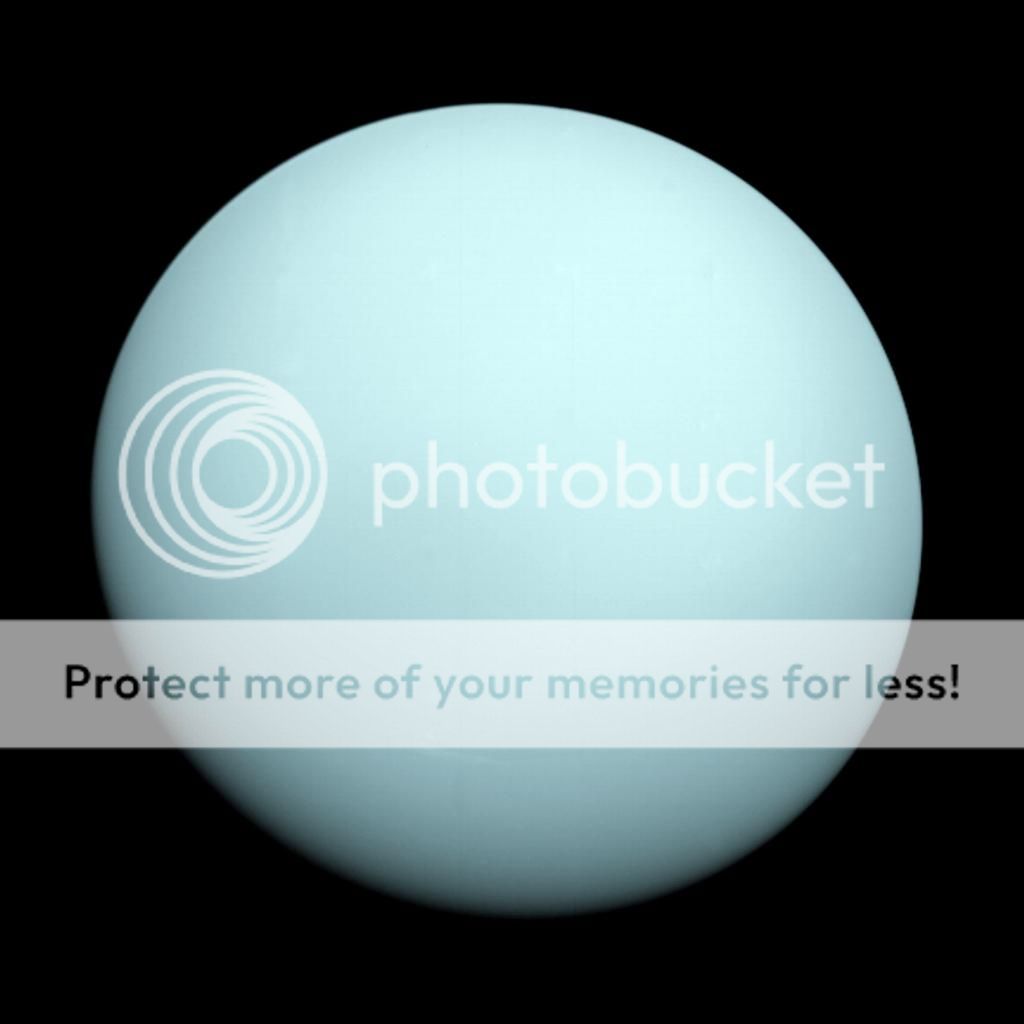
(Image credit: NASA)
Uranus is only half as big as Saturn, and twice as
far away from both Earth and the Sun's light. Due to this, it's far
dimmer, so dim in fact it wasn't discovered until 1781. Uranus is
just bright enough to be seen with the naked eye outside of cities,
but this is hard to do. With binoculars or a telescope it's visible
quite easily, with just one problem: how do you distinguish it from
thousands of dim stars?
Well, with a map of course. I've found it myself
using a map like the one linked below: it's a tiny blue light in a
telescope, which becomes a minuscule little blue sphere at high
magnification. Right now Uranus is in Pisces, where it'll be visible
in the evenings during the first months of the year, behind the Sun
in April and May, visible in the morning from June to September, and
visible all night long as the Earth passes between it and the Sun in
October and November. It's a difficult planet to find, but very cool
to have seen.
The chart is located here:
http://dcford.org.uk/findercharts.php?obj=uranus&year=2013.
It's no mistake that Uranus doubles back on its path in August: this
is a perspective effect caused by Earth overtaking it.
Neptune

(Image credit: NASA)
Neptune is even farther away than Uranus, and so
even dimmer. It's theoretically visible to the naked eye under
absolutely ideal conditions (very, very far away from any lights
(We're talking Antarctica here), an incredibly clear sky, preferably
on a mountain top or in space, when the Sun is very far beneath the
horizon and Neptune high in the sky, there's no Moon, no Venus, and
you've got very good eyes. Then you might just
be able to glimpse a hint of it), but I don't think anyone has ever
actually seen it with the naked eye. It's still visible through
binoculars and telescopes though (though I have never seen it
myself). You'll need a map of the area of Aquarius where it can be
found (best in August, when Earth passes between Neptune and the
Sun). This map is fortunately supplied by the same site that gave us
the one for Uranus:
http://dcford.org.uk/findercharts.php?obj=neptune&year=2013
*=Coincidentally**
exactly as long as an elephant pregnancy.
**=Or not. Maybe
elephants come from Mars.
